
Avoid choosing by label
Cloud, private and hybrid architectures each involve tradeoffs. A label alone does not establish security, cost, performance or suitability.
Start by mapping the workflow, data sources, users, retention needs and operational responsibilities.
Compare the practical requirements
For each candidate pattern, check data movement, identity and access, vendor terms, integration interfaces, model behavior, logging, support and ongoing ownership.
Keep the decision specific
Different workloads in one organization may have different requirements. A low-risk internal knowledge helper and a sensitive document workflow do not automatically need the same architecture.
Map a single request across its boundaries
Take a customer asking about an order. The voice service may process the speech, a workflow may check the caller’s entitlement, and an ERP interface may return a few permitted status fields. A model then prepares a response from that narrow context. Mapping those steps reveals where information travels and which component owns the next decision.
A private model alone does not settle the entire privacy question. Speech processing, logging, backups, support access and external tools may still move or retain information elsewhere. Conversely, a managed cloud service can offer controls worth evaluating. The architecture decision belongs to the complete data path.
Make the tradeoffs operational
Compare latency, cost, regional availability, model quality and the skills needed to run the system. Private infrastructure requires patching, monitoring and capacity planning. Managed services require a careful review of provider terms, service boundaries and data-use settings. Neither arrangement removes the need for evaluation or accountable ownership.
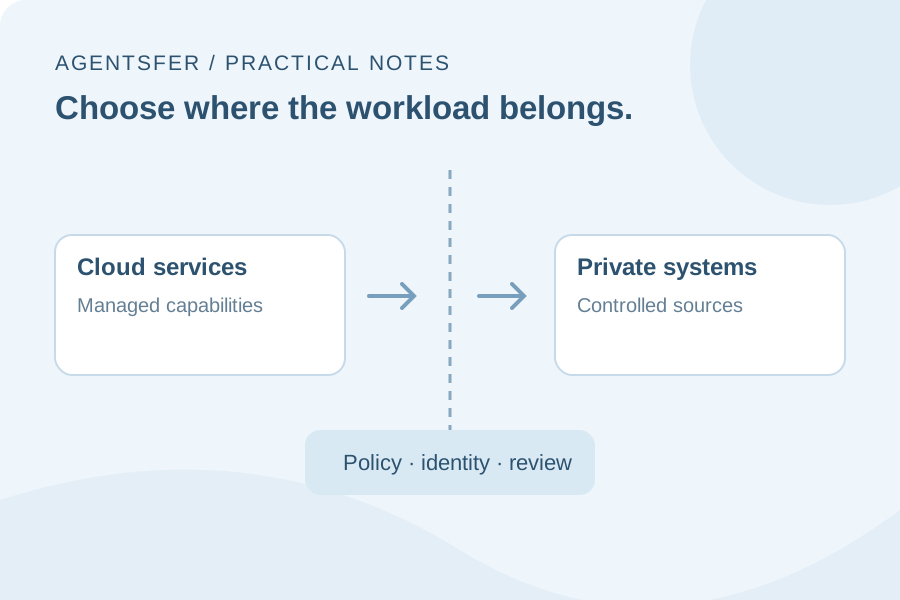
A hybrid design can keep selected sources inside a controlled boundary while using a suitable managed capability for another part of the workflow. That split should be deliberate. Describe what crosses the boundary, why it is needed and what happens when a component fails.
Evaluate before making the pattern permanent
Use representative tasks and approved sample data to compare candidate designs. Record answer quality, source traceability, response times and failure behavior. Include uncertain requests and access denials rather than testing only the happy path.
The outcome should be a documented choice for a specific workload, with known limits and owners. Revisit it when the data, model, business process or provider terms change. Architecture labels are a starting point for a conversation, not evidence that a system is secure or compliant.
Start with a practical question.
Explore a preliminary assessment or talk through a business challenge.